
R S Tejus:
The recent tiger incident near Berambadi village in Bandipur is not just about a young tiger entering farmland. It has brought out a deeper problem — the lack of calm dialogue, weak public understanding of wildlife behaviour, repeated crowd interference during rescue operations, and the growing confusion around what real conservation should be.
This issue must be seen in a larger context. It concerns the forest department, farmer organisations, local communities, the government, donors, and all those who speak in the name of conservation. Unless each of these groups looks at its own role honestly, such incidents will continue to repeat.
A sensitive rescue operation was disrupted!
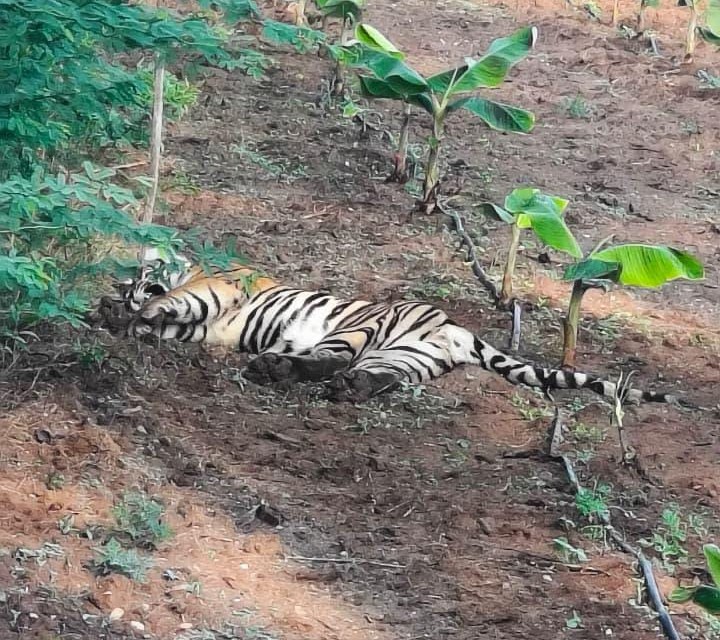
On March 23, a young tiger was found near Berambadi village in Bandipur, close to the highway. In a situation like this, the rescue operation becomes highly sensitive from the very first moment. The animal has to be handled carefully. The area has to be fully controlled. Civilians must be kept away. There should be no shouting, no crowding, and no unnecessary disturbance.
Understanding the seriousness of the situation, Bandipur Tiger Reserve Director Prabhakaran immediately sought the intervention of the Tahsildar, and Section 163 of the BNSS was invoked. This was necessary because tiger capture operations are not routine exercises. They require discipline, space, coordination, and public restraint.
However, even after Section 163 was in force, people gathered in large numbers. Instead of allowing trained personnel to do their work, the rescue site turned into a place of shouting, questioning, and public interference. That itself is a serious matter.
The crowd made the situation worse.
During the operation, the forest department and the police had reportedly requested the public not to go near the tiger, not to shout, and not to do anything that could irritate the animal after it had been darted. This is basic protocol. A tiger that has just been darted remains in a delicate and unpredictable state for some time. If left undisturbed, the operation can proceed safely. If disturbed, the situation can change within seconds.
According to sources, many among the gathered crowd were drunk. Instead of stepping back, they created chaos at the site. That disturbance appears to have agitated the tiger, which then pounced on a member of the department staff. This point is extremely important. The injury to the staff cannot be seen as an isolated event. It is linked directly to the crowd behaviour and the failure to respect a live rescue operation.
Even in farmland, a tiger left undisturbed will often avoid conflict. But once a large crowd moves in, shouts, pressures the rescue team, and irritates the animal, the danger rises sharply. This is why the incident cannot be explained only as a tiger problem. Here human behaviour is also a major problem.
Farmer organisations must be heard, but they must also act responsibly.
Raitha Sanghas and farmer organisations have every right to raise issues such as crop raids, fear, livestock loss, and the daily burden of living near forests. These are genuine concerns. They deserve attention and response.
But farmer organisations also have a responsibility to speak with balance and honesty. If they are asking why the tiger entered farmland, then they must also answer a basic question: have tigers never entered farmlands before? Wildlife movement in forest-fringe areas is not something new. So why is there suddenly such a sharp public outcry now?
They must also ask why they are not equally vocal about the steady encroachment of forest lands. Why is the anger directed only at the tiger and the forest department? Why are they not speaking with the same force about shrinking habitats, pressure on forest edges, and the human role in increasing conflict?
Most importantly, why are farmer organisations not clearly telling people that it is wrong to gather in large numbers during a rescue operation? Why are they not openly saying that interfering with public servants, crowding the animal, and creating a mob situation can directly lead to injury and disaster?
If farmer organisations want to play a constructive role, they must guide people towards responsibility, not just amplify anger. Blaming only the department, wildlife, or safaris is not the answer. In recent times, it has become common to blame the forest department for every incident. It has also become common to blame the tiger itself. Sometimes, safaris too are dragged into the discussion, even when they have no clear connection to the immediate cause of the incident.
This kind of one-sided blaming will not solve anything.
The tiger incidents of 2025 also cannot be spoken about in a selective way. In those cases, human actions matter. Stones were thrown. The animal and its cubs were endangered. That context cannot be hidden. But such facts are rarely spoken about with the same force. Instead, the easier route is chosen — blame the department, blame the tiger, blame safaris, and create outrage.
That may bring attention on social media. It may bring likes, followers, and public applause. But what has actually been achieved in the end? Has conflict reduced? Has trust improved? Has any practical solution emerged? The answer is clearly no.
Selective videos and social media outrage are deepening the problem. Another major problem is the spread of selective and biased videos on social media.
A short clip, a dramatic claim, or one emotional angle is enough to shape public opinion. But many such videos do not show the full sequence of events. They do not show what happened before. They do not show whether the animal was provoked, who ignored warnings, or who disrupted the operation?
This selective storytelling is making an already sensitive issue worse. It creates instant outrage, but not real understanding. Wildlife conflict cannot be discussed through half-truths and edited moments. It needs facts, context, and patience.
What is needed is one common dialogue.
The real need now is not more noise, but more dialogue. The sudden rise in organised public anger must be investigated. Tiger presence in farmland is not entirely new in landscapes like Bandipur. If that is so, then why is there now such a sudden spike in public anger, organised outcry, and mob behaviour?
This issue needs a proper investigation. The government must take cognisance of repeated incidents where people gather and interfere even when Section 163 is in force. It must examine whether this is being driven by fear, frustration, lack of awareness, alcohol-fuelled crowding, political influence, social media amplification, or organised mobilisation from behind the scenes. Unless the real causes are identified, the situation will only become more difficult to control.
There has to be one common platform where farmer organisations, the forest department, police, revenue officials, scientists, real field experts, local communities, and the wider public can come together and speak honestly. Forests are public property. They belong to all. So, the responsibility of protecting them, understanding them, and discussing conflict around them also belongs to all.
Such dialogue must go beyond one-day meetings and token protests. It has to deal seriously with crop raids, compensation, animal movement, rescue protocols, crowd behaviour, habitat loss, corridor protection, and the duties of both the state and the public. Without such structured dialogue, every new incident will become another cycle of anger, blame, and confusion.
Real awareness must replace token awareness.
There is a lot of talk about awareness, but what is needed is not symbolic awareness. It is not enough to speak only about planting trees, feeding wildlife, or distributing materials. The awareness that is needed in forest-fringe landscapes must be fact-based and rooted in the Constitution, the law, rights, duties, ground realities, the ecological importance of forests, and the behaviour of wild animals. People must understand what public servants are legally empowered to do during dangerous situations. They must also understand what responsibilities ordinary citizens carry in return.
This kind of awareness must be built by real experts — serious field biologists, ecologists, experienced frontline staff, administrators, and legal experts who understand both the forest and the people living around it. It cannot be left to pseudo-experts, random speakers, or shallow campaigners who know little about the ground reality.
Conservation funding must support real ecological needs.
The way conservation money is being spent also needs urgent review. Too often, CSR funds are used for poorly thought-out activities such as digging waterholes deep inside forests, creating water-harvesting pits in natural forest systems, installing solar towers, and funding other visible interventions that may look impressive on paper but can actually increase disturbance.
Forests are not empty spaces waiting for constant engineering. They are already natural water harvesters and complex living systems. Repeated physical intervention inside forests can do more harm than good. This is why waterhole digging along boundaries and inside the park must be avoided. The use of JCBs and other heavy earth-moving machinery in such ecologically sensitive areas should also be stopped. A tiger reserve cannot be treated like a construction site.
If conservation funds are genuinely meant to help forests, they should support work that has long-term ecological value — securing corridor lands, buying private lands that connect one forest to another, supporting voluntary relocation from critical habitats, and protecting landscape connectivity. These are difficult tasks, but they are far more meaningful than random visible projects.
Too many voices speak for conservation without doing the real work.
A deeper problem today is that many people speak in the name of conservation without understanding what it actually requires. Some donors and organisations appear to be poorly informed or more interested in visible activity than ecological sense. At the same time, people with little field knowledge are invited to speak on highly complex subjects such as wildlife conflict, forest governance, and habitat management.
This weakens public understanding. There are now too many players speaking for conservation, but not enough serious attention being paid to the forest itself. Conservation cannot be built on performance, shallow expertise, and public image. It needs depth, field presence, and long-term commitment.
A larger truth must also be remembered.
The earth does not belong to human beings alone. Every creature has as much right to live on this planet as we do. We have no right to dominate, dismiss, or question the very existence of other living beings simply because they inconvenience us. Wildlife is not occupying our world; we are all sharing one world together. If conservation is to mean anything, it must begin with this basic understanding: humans are not the only rightful inhabitants of the earth and they evolved very much later compared to other species.
The Bandipur incident is a warning. It shows what happens when fear, anger, alcohol, selective videos, weak awareness, misplaced funding, and mob behaviour come together around a live wildlife operation.
People living near forests have real problems, and their voice must be heard. But that voice must become constructive. It cannot become a crowd that obstructs rescue work, blames only the tiger, and refuses to examine its own role.
Likewise, conservation cannot survive on token activity, shallow expertise, badly directed funding, waterholes dug by heavy machinery inside forests, and endless public blame without accountability.
What is needed now is simple but serious: calm dialogue, fact-based awareness, ecological honesty, legal understanding, responsible leadership, and respect for both people and wildlife.
Anything less will only deepen the conflict.