
Manjunath S Nayak:
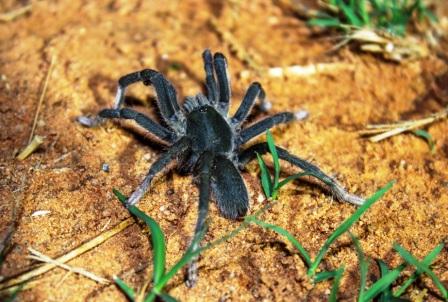
A rare Tarantula spider species was found near Bengaluru recently. This has been confirmed as a rare species and it is known as White socks tarantula spider (Neoheterophrictus sp).
The White socks tarantula spider species was spotted when Sunil Kumar, a wildlife photographer & nature lover along with his family were herping in their village Maralakunte near Bengaluru. In fact, this giant spider caught the eyes of his son Kuladeep who captured the species on camera and took a close up of this giant spider.
Dr Abhijit APC, Team SALIGA who is a well-known spider expert confirmed the identity of this giant spider. Neoheterophrictus is a genus of tarantula in the family Theraphosidae. All 8 species of such spiders are found in India. Neoheterophrictus tarantula is endemic to the Western Ghats of India, with eight recognized species belonging to this family.
The 8 recognized species are the following:
- Neoheterophrictus amboli (Mirza & Sanap, 2014),
- Neoheterophrictus bhori (Gravely, 1915),
- Neoheterophrictus chimminiensis (Sunil Jose, 2020),
- Neoheterophrictus crurofulvus (Siliwal, Gupta & Raven, 2012),
- Neoheterophrictus madraspatanus (Gravely, 1935),
- Neoheterophrictus sahyadri (Siliwal, Gupta & Raven, 2012),
- Neoheterophrictus smithi (Mirza, Bhosale & Sanap, 2014),
- Neoheterophrictus uttarakannada (Siliwal, Gupta & Raven, 2012).
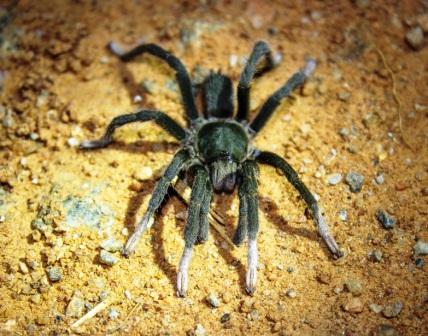
Neoheterophrictus tarantulas are ground-dwelling brush-footed tarantula spiders and they are primarily found in the Western Ghats of Karnataka, Kerala, and Gujarat. These giant spiders are characterized by distinct multi-lobed spermathecae and, in males, a unique double tibial spur. They are often found in deciduous forests and hilly regions.
Why are they called White socks tarantula spider?
They are thus named for their distinctive white markings on its leg’s tip or tips of the limbs that resemble wearing like fuzzy socks hence, this ground dwelling tarantula is also called White socks tarantula spider. These spiders are known as impressive burrowers and excellent hunters.
These giant spiders are often dark brown to green-black, with some, like N. sahyadri, showing white markings on their tarsi (the seventh segment of the leg in spiders). They are known for their restricted, narrow-range distribution. Species vary in their body colouration but often possess black-green bodies (N. sahyadri) or grey-brown tones (N. uttarakannada).
Unique Features of Giant Spiders
The males of some species, such as N. sahyadri and N. crurofulvus, display distinctive bright white or cream-colored tarsi and meta-tarsi on their legs. They are often described as miniature tarantulas.
The genus Neoheterophrictus was defined in 2012 by researchers Manju Siliwal, Neha Gupta, and Robert John Raven to classify spiders that showed unique features distinct from Plesiophrictus and Heterophrictus. These are two distinct genera of Theraphosid spiders (tarantulas).
Found in Western Ghats
The Theraphosid spiders are found exclusively in India, specifically along the Western Ghats range in Karnataka, Maharashtra, and Kerala.
These tarantula spiders build temporary, shallow burrows under rocks, in leaf litter, or sometimes within bamboo forests. They feed on small insects and arthropods. In captivity, they have been observed eating crickets and cockroach nymphs.
Critical Threats to these Species
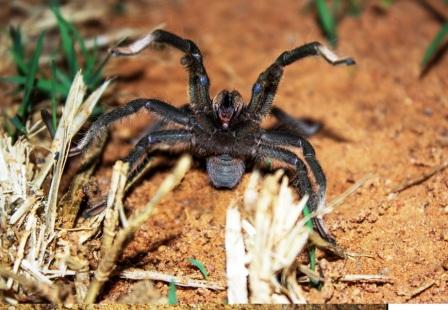
These tarantulas face threats from habitat destruction due to deforestation, landslides, and floods in the Western Ghats. They are also subject to illegal collection for the exotic pet trade, with many specimens sometimes sold in Europe and other countries to spider pet keepers.
Tarantula spiders face critical threats from habitat loss, illegal pet trade, and climate change which fragment populations and drive declines.
Conservation Efforts
Conservation efforts, including CITES protection, habitat protection, and captive breeding programs, are essential to stop their decline.
Key actions include managing in-situ habitats, regulating tarantula spider trading, and conducting further ecological research. Educational initiatives are used to highlight the need to protect these species. In addition to Neoheterophrictus, other Indian endemic genera like Poecilotheria (Ornamental tarantulas) and Haploclastus are also heavily targeted for illegal trading.
Species found only in India
All Neoheterophrictus species are restricted to India and are not found in the wild elsewhere in the world.
Indian ornamental tree spider Poecilotheria regalis is a species of arboreal tarantula that was rarely sighted in urban areas of Bengaluru.

Need for studies in Eastern Ghats
The Eastern Ghats and Bayalu Seeme (scrub forests of the Karnataka plateau) are critical, yet under-explored, habitats for several species of mygalomorph spiders, including Tarantulas (Theraphosidae) and Trapdoor Spiders (Ctenizidae/Idiopidae).
The presence of these spiders, many of which are endemic and endangered, is often restricted to dry thorn scrub, deciduous forests, and rocky terrains where they construct silken burrows, live under rocks, or inhabit tree hollows.
(PHOTO CREDIT: S KULADEEP, YOUNG WILDLIFE ENTHUSIAST, BENGALURU)