
Meera Bhardwaj:
Another death of a captive animal – Hippopotamus – due to “clear lack of expertise in wildlife veterinary skills” at a zoo in Karnataka! This seems to be happening quite frequently in Karnataka zoos be it in Bengaluru, Belagavi, Gadag, Davangere and now Shivamogga in the state.
The death of an Indian Gaur, 31 blackbucks, a Nilgai, four spotted deer and the amputation of an elephant’s earlobe at Sakrebailu and now a hippopotamus is staring at us with no action in sight from the State Government.
In the background of these terrible repetitive incidents of wildlife deaths in Zoos of Karnataka:
- When will the state government set up a “Permanent Wildlife Veterinary Cadre?
- When will they recruit experienced wildlife vets” in Karnataka?
- When will they stop hiring vets on contract?
- When will they review and upgrade safety protocols at the Zoo?
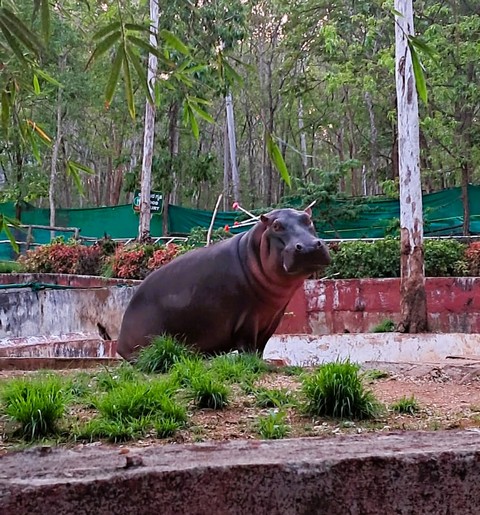
HAMSINI – THE UNLUCKY HIPPO
This time – it is an 8-months pregnant African Hippopotamus at the Shivamogga Zoo, Tyavarekoppa. Last time, it was a pregnant Indian Gaur in the Bannerghatta Biological Park. “Unfortunately, both the female hippopotamus and the Indian Gaur were darted many times by the same vet from the Bannerghatta Zoo despite being pregnant,” wildlife vets in Karnataka bemoan.
Further, another case of lack of wildlife veterinary skills – a 35-year-old Balanna, a Sakrebailu camp elephant lost his precious earlobe in October 2025 due to a botched up, mistaken injection administered into his ear nerve instead of a leg muscle.
Such cases are becoming frequent in zoos of Karnataka as the vets from the Animal Husbandry department have no knowledge or experience dealing with wildlife – that too carnivores and mega-herbivores like the gaurs, elephants, hippos and tigers and leopards.
Now what Killed the Hippopotamus?
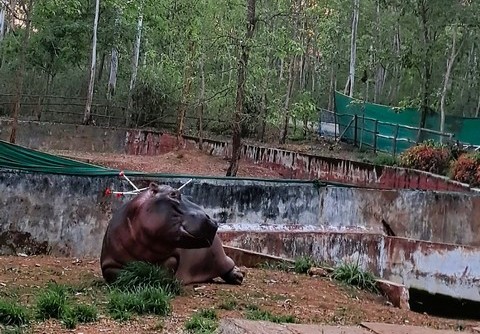
Hamsini, this massive Hippopotamus which died had become nationally famous as she had attacked Zoo Vet Dr Sameeksha Reddy (who died of her injuries) while checking on the hippo inside her enclosure, last month.
According to a press statement released by the Executive Director, Shivamogga Zoo, Lion & Tiger Safari, Tyavarekoppa on 14.04.2026, Hamsini, the 12-year-old Hippopotamus died at 3.08 pm on April 14, 2026 due to acute sepsis and a failed pregnancy.
TRAGIC TALE OF HIPPO HAMSINI
Housed in the Shivamogga Zoo from 2022, the hippo had faced many problems when its first calf had to bear the brunt of male aggression and the second time in 2024, her calf drowned. The third time, that is now, it suffered intra-uterine foetal death due to an infection. The last 10 days, the hippo had turned immobile, become inactive and had no appetite.
Following her deteriorating health, vets from Bengaluru and Mysuru were called in for guiding the Shivamogga Zoo. Authorities requisitioned the help of Bannerghatta vet Dr Anand who incidentally darted a pregnant Indian Gaur, resulting in its death and an inquiry was instituted by the concerned authorities.
HIPPO HAMSINI’S SUFFERINGS
1. Shallow respiratory rate.
2. Not taking any feed.
3. Forcible hand feeding.
4. Body temperature not able to record.
5. Failed in giving oral antibiotics.
6. Very sluggish movement.
7. Foul smelling discharge through vagina.
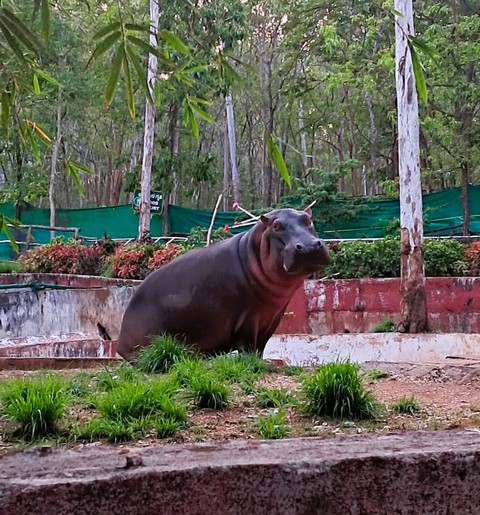
In a letter to Member Secretary, Zoo Authority of Karnataka, Dr Vinay S, Assistant Director, Shivamogga who is an experienced wildlife vet for 13 years and has worked in both Mysuru and Shivamogga Zoo outlines the failure to save the hippo.
Having vast experience in dealing with animals in both captivity and wild, Dr Vinay S has questioned and raised many aspects on the line of treatment provided to Hamsini, the hippo.
He states, “The two visiting vets who arrived in Shivamogga Zoo on 8th and 9th April for clinical investigations and diagnostic purposes of Hamsini which was suffering from delayed parturition (giving birth) and was off feed for last 28-30 days – failed completely in their treatment approach. They darted the hippo 6 times on the upper part of the body (neck region) which is not at all ideal site for darting. The ideal site for darting is the rump region or upper part of the shoulder region”.
Since this hippo was already stressed with minimal movement within the hippo enclosure, they should have taken proper position with a distance of 20 meters and darted perfectly at the wide area of the thigh region having highly muscular area keeping proper air pressure in the darting gun to achieve proper sedation by perfect darting. But here they failed completely and darted at the dorsal part of the neck region where we can notice more of skin folds.
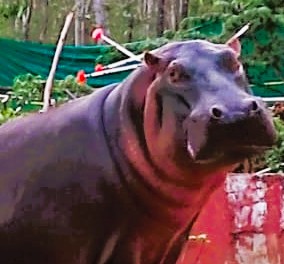
MUTLTIPLE DARTING OF HIPPO
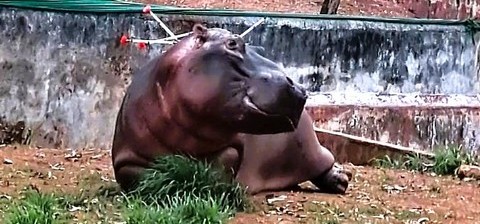
What seemed like a routine immobilisation in fact, turned into a tragedy. If you look closely at the hippo’s image. Not one, but multiple darts has pierced the thick body at various places.
The Myth of “Just Another Procedure”
A veterinary expert from Delhi says, “Immobilising a hippo is not a routine act. It is one of the most complex, high-risk interventions in wildlife veterinary practice. This is an animal evolved to withstand pressure, both physical and physiological – thick skin, dense subcutaneous fat, and a metabolism that does not respond predictably to drugs designed for precision.
He adds, “Multiple darts indicate repeated attempts. Repeated attempts indicate uncertainty which is often fatal. In an animal like a hippo already adapted for aquatic breath-holding, darting becomes a dangerous paradox.” But when multiple darts were delivered to the hippo Hamsini:
- Drug absorption became erratic
- Effects became staggered and unpredictable
- Overdose becomes not just possible, but likely
- It received a cascade of pharmacological shocks.
- And in that cascade, systems began to fail.
- A Body that could not breathe
This shows their efficiency & knowledge in darting procedures, Dr Vinay says and adds, “Multiple darting significantly increases anaesthetic risk due to unpredictable cumulative dosing, variable absorption from each site – staggered drug uptake. They have darted all the dart syringes with the collared needles which remained intact in the hippo’s body till the next morning as they could not achieve proper sedation of the animal in spite of 6 darts. Due to multiple darting with chemical agents of overdose, the possibility of respiratory depression, sudden apnea, cardio-vascular instability might have resulted in the hippo.”
Post-darting complications is particularly dangerous in hippos due to its thick skin, subcutaneous fat and erratic drug kinetics and high sensitivity to opioid based protocols.
More the darts, more the risks.
In his letter to ZAK, Dr Vinay further stresses, “More than one dart should not be done specially in stressed and weak animal but only in exceptional cases, they can give second dose supplemental – justifying the reason as per the guidelines. Everyone knows. Even Dr Madan darted excessive dosage of anaesthesia for the Indian gaur in the free range in Davangere district five years back which succumbed to its death. Dr Anand who darted a pregnant gaur in Bannerghatta in October 2025 – led to its death. Both of them should have consulted experienced Wildlife Vets before doing such darting operations. Now, we have lost the mother hippo.”
He outlines, “Three deaths have occurred in a span of one month in Shivamogga Zoo – Dr Sameeksha Reddy, the calf and the mother Hippo. It is completely the negligence of the Executive Director, Dr Murali and now the two visiting vets should be held responsible. Knowing that this hippo is progressively anorectic, not taking any feed for last 28 days which they clearly state in the clinical history reported in Clinical Investigation and Diagnostic Report dated 11.4.2026”.
After achieving proper sedation on 10th April, Dr Vinay says the two vets:
- should have treated the hippo symptomatically by administering the intravenous fluids, long-acting antibiotics, anti-inflammatory, Vit B1, B6, B12 injections.
- Along with this, they should have administered Prostaglandin hormone injection to remove the dead foetus from the uterus
- as it was suffering from endotoxemia resulting in stop in feeding for last 28 days.
- They had failed to give proper line of treatment by not consulting the gynaecologist to save the hippo from its suffering, thereby, delaying parturition.
In fact, Dr Vinay adds, “Dr Murali had stopped taking care of the very sick hippo from March 10 and only re-started from March 23 to get his relieving orders. With no doctor, this shows there is negligence of Executive Director by not instructing him to monitor and to treat the hippo and to report him the daily health condition of the hippo. At least, they could have taken an early decision in consulting the MS, ZAK to send Wildlife Veterinary experts from others Zoos & consulted a gynaecologist for proper line of treatment for delay in parturition.”
If they had called me, the wildlife vet says, “I would have guided them and given some inputs for proper line of treatment and approach to save this animal. Since April 1st 2026, there is no Vet at the Shivamogga Zoo for the health management of different species, including this hippo. Only a Vet must check the quality of feed and meat before providing to all the species in the Shivamogga Zoo. How the ED has managed the Zoo without a vet for almost 10 days is unbelievable?”
An Enclosure With Inadequate Water, A Procedure Without Margin
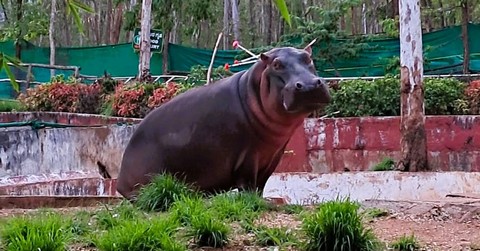
A wildlife biologist says, “The images reveal another quiet truth. The enclosure itself appears dry. For a semi-aquatic species, water is not a luxury, it is biology. It regulates temperature, supports skin health, and provides psychological refuge. When an animal is already outside its ecological comfort zone, every additional stressor compound risk.”
A compromised environment meets a compromised procedure. The result is predictable. Now why should we bring hippos from their natural environment in Africa for them to die such a death in our zoos?
The Ethics of Control
Modern wildlife management often prides itself on moving away from lethal control. Immobilisation is just a humane alternative – a tool of care, not harm. But tools are only as humane as the hands that wield them.
When standard protocols are not followed, when precision gives way to repetition, when monitoring lags behind intervention, the line between care and harm blurs dangerously.
This hippopotamus did not die because immobilisation is inherently flawed. It died because immobilisation was not executed with the rigour it demands.
What Must Change?
This death must not be archived as a routine loss. It must be documented, dissected, and discussed. Training must be uncompromising: Megafauna immobilisation is a specialised skill, not a general procedure.
One-dart protocols must be enforced: Repeat darting should be the rare exception, not a fallback strategy. Monitoring must be immediate and continuous: Respiration, reflexes, and positioning are not optional observations.
Reversal readiness must precede action: Not follow it. Enclosure design must align with species biology: Welfare is not separate from clinical outcomes—it is foundational to them.
One can only hope that there is no such cases like the Hippo Hamsini in the coming days, otherwise, stop keeping wildlife in zoos for people’s entertainment and education.