
Sachin Gowda:
Snakes are one of the most mysterious, evolutionarily successful and behaviourally complex reptiles found on Earth. Recent and ongoing research reveals that they exhibit and display rare, sophisticated, survival and social behaviour.
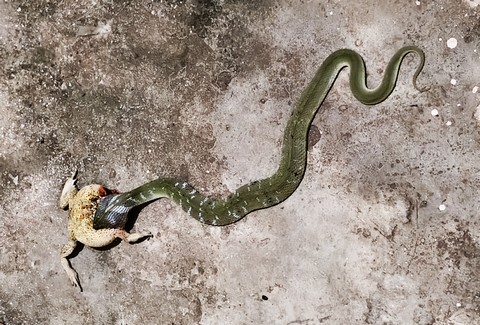
One of them is the Green Keelback snake that consumes toxic toads to kill its predators in a very smart manner. And such a survival behaviour which is a rare phenomenon has now been observed in green keelbacks in Karnataka.
HEAD BENDING STRATEGY
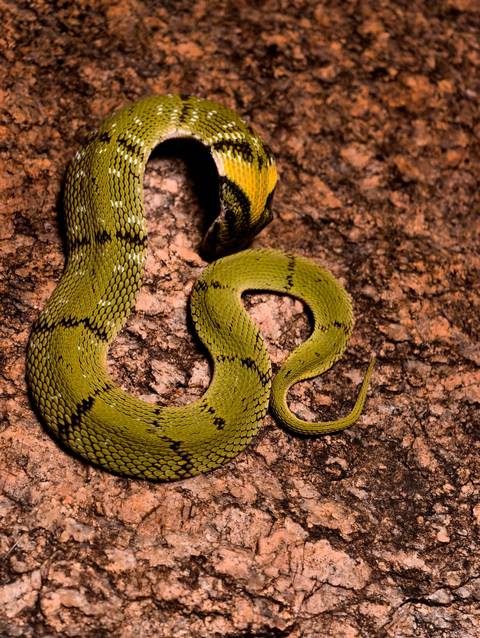
The green keelbacks (Rhabdophis plumbicolor) use the head-bending strategy to expose its nuchal glands as a highly specialized chemical defence mechanism. Since these snakes lack deadly venom to protect themselves from large predators, they rely on a unique “poisonous” evolutionary adaptation.
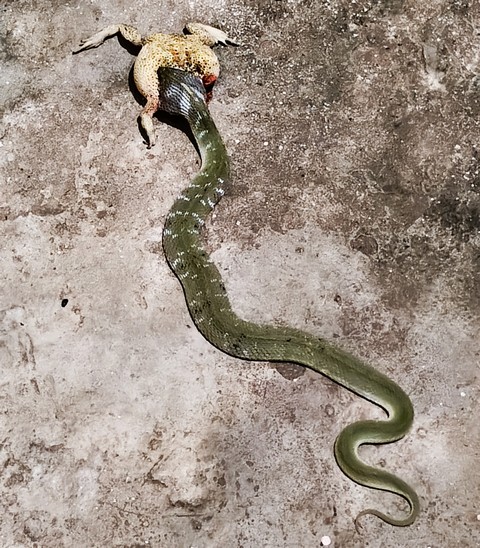
Green keelbacks hunt and consume toxic toads. The amphibian which is being consumed by the green keelback snake in the thumbnail picture is the Asian Common Toad and it is poisonous.
NUCHAL GLANDS
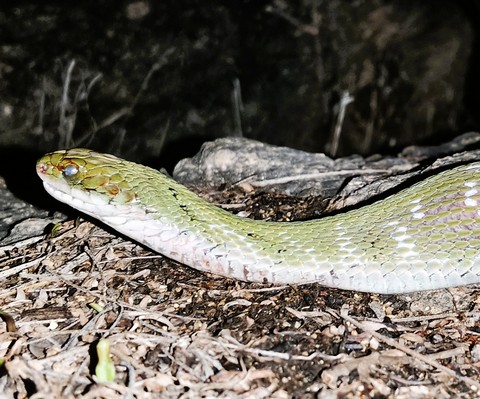
Instead of being harmed by the toads’ toxins (bufadienolides), the green keelback snake absorbs and stores them in its nuchal glands. These are located right beneath the skin on the back of their necks.
When a predator approaches, the snake arches its neck and bends its head downward. This specific head bending strategy and posture stretches the skin, causing a ridge to form, thereby, pushing the gland-bearing area directly toward the attacker.
GLAND BURSTING DUE TO STRESS
Unlike standard venom glands, nuchal glands do not have ducts or exit holes connected to fangs. They are fluid-filled sacs embedded directly under the dermal layer. For such a defence mechanism to work, the nuchal glands must physically rupture under mechanical stress. By flexing its neck and bending its head, the snake creates skin tension.
When a predator bites that exact spot, the glands burst open, immediately spraying or leaking a highly irritating, bitter, and dangerous steroid fluid directly into the predator’s mouth or eyes.
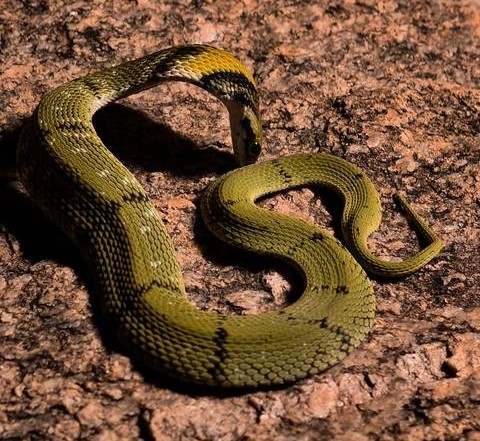
Meanwhile, the observation of this rare behaviour as a defence mechanism in green keelbacks which I saw has been confirmed with researchers in India. This behavior was observed on September 6th in an uncultivated agricultural land in Tumakuru taluk, Tumakuru district, Karnataka at 9.30 pm.
This is the first time such a type of rare behaviour has been seen wherein green keelbacks consume toxic toads to store the amphibian’s poison in its nuchal glands and later use it for protection against predators and kill them.
GROUND DWELLING SNAKES
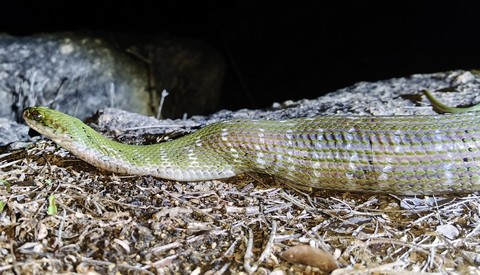
The green keelbacks are a ground dwelling snakes widely distributed throughout Peninsular India, central-eastern India, and all southern regions. It is generally found in plains and moderate elevations up to 2,000 meters. The green keelback snakes belongs to the genus Rhabdophis.
These snakes have absolute specialty of the snake genus Rhabdophis (commonly known as keelbacks). Further, they are among the exceptionally rare creatures on Earth that are both venomous and poisonous.
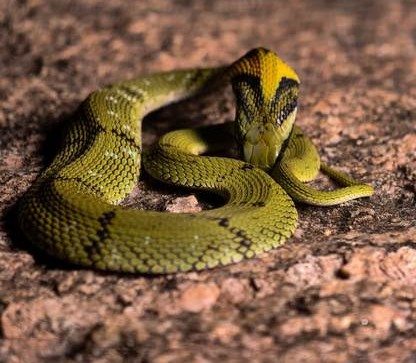
SHIFTED TO GENUS RHABDOPHIS
Earlier, the green keelbacks belonged to the Genus Macropisthodon but later in 2018, they were re-classified and shifted to Rhabdophis because molecular DNA evidence proved that the old genus Macropisthodon was artificial and scientifically invalid (paraphyletic).
Apart from this, the genus Rhabdophis are the only group of snakes in the world which are both venomous as well as poisonous. However, green keelbacks’ venom status – it is harmless to humans and are considered non-venomous.
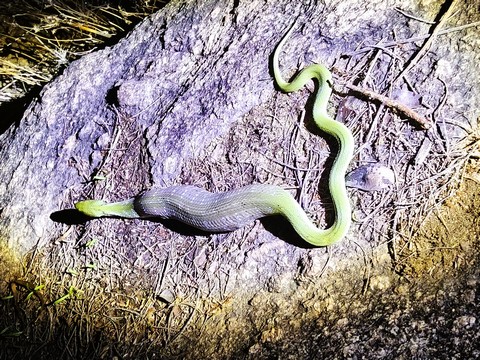
DEFENSIVE BEHAVIOUR
Generally, green keelbacks do not display this defensive posture as observed in the picture regularly, so, this was for the first time, I saw this behaviour. Till date, I have observed some 300-400 individuals in the past decade.
The other related species which lives in North East India exhibits this defensive mechanism behaviour. But the snake displaying this rare behaviour is the Red Necked Keelback (Rhabdophis subminiatus). This snake is venomous & poisonous to humans but the one found in southern parts of the country is considered harmless to humans.
(Sachin Gowda is a researcher in the field of wildlife ecology & conservation, works with Wildlife Awareness & Reptile Conservation Organization (WARCO), he has 8 research papers on Academia.edu. And he has photographed the images of green keelback.)
(The other images of green keelbacks consuming the toxic toad and its consumption are by Yogananda S N)