
Manjunath S Nayak:
Langurs represent one of the most diverse and species-rich primate groups in Asia. Yet their taxonomy and bio-geographic history have remained contentious for decades.
Dr Praveen Karanth, Dr K S Chetan Nag have conducted molecular studies in the laboratory of Indian Institute of Science( IISC), Bengaluru over the past 20 years and provided clarity about langur classification.
One Langur or Many? Untangling a Century of Confusion in India’s Most Familiar Monkey
For decades, the grey langurs seen across India on temple steps, roadside trees, dry scrublands, and dense forests were all thought to belong to a single species. But behind this familiar face lay a century of scientific confusion.
Were these monkeys truly one species? Or were they several, hidden under one name?
Early taxonomists disagreed sharply. Some classified them under Presbytis, others under Semnopithecus. At the species level, things became even messier. Many researchers grouped all grey langurs into one species –Semnopithecus entellus divided into multiple subspecies.
Later, new classification schemes proposed as many as seven distinct species. Distribution maps were equally confusing, often overlapping or contradicting each other.
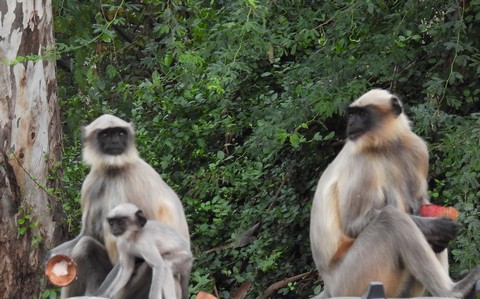
A curious field observation offered one of the first clues: tail carriage.
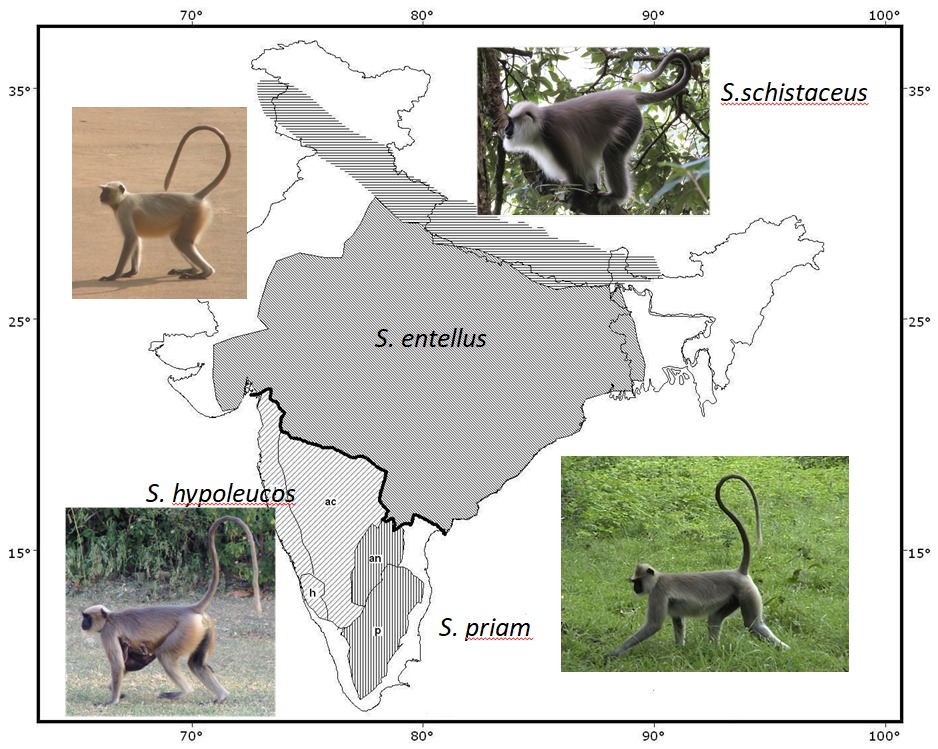
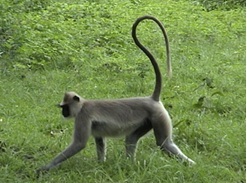
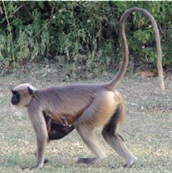
North Indian langurs typically loop their tails forward toward their head. In contrast, South Indian langurs carry their tails in an inverted U or S shape, curving away from the head. Strikingly, this divide aligns roughly with two major river systems, the Narmada and the Krishna forming a natural geographic boundary between northern and southern forms.
To test whether these visible differences reflected deeper evolutionary splits, extensive field surveys were carried out across Karnataka. The study did not focus on a single habitat, but spanned a remarkable ecological range.
Across these diverse landscapes – dry scrub, moist deciduous forest, evergreen rainforest, riparian belts, hill tracts, and human-modified habitats – researchers documented key morphological traits:
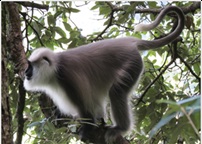
- Presence or absence of a crest
- Presence or absence of facial streaks
- Extent of black coloration on hands and limbs
- Tail looping pattern
These field observations were then integrated with genetic analyses and ecological niche modeling.
The results were decisive.
South India does not host a single grey langur species.
Instead, two distinct species occur there:
Semnopithecus hypoleucos
Semnopithecus priam
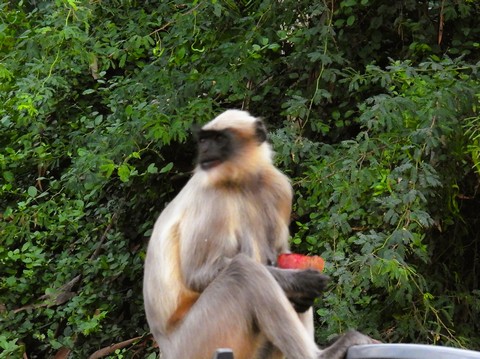
These are evolutionarily separate from the northern Semnopithecus entellus. Meanwhile, the darker, forest-dwelling Nilgiri langur (Semnopithecus johnii) forms a sister lineage to the southern Hanuman langurs.
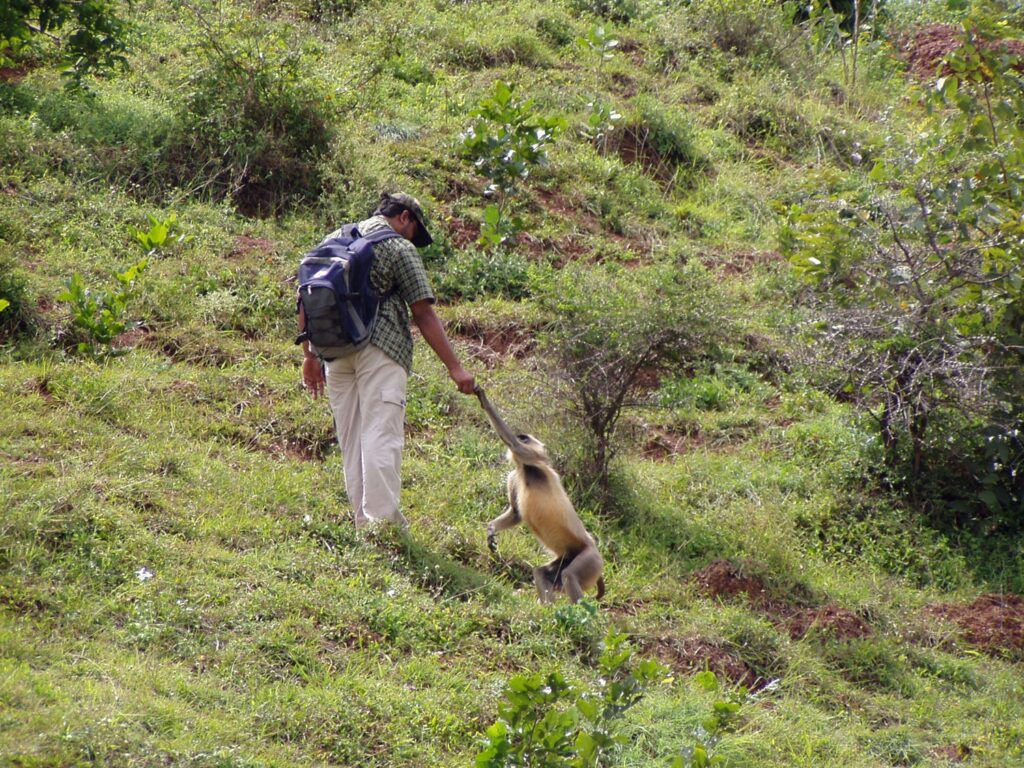
This integrative evidence – morphology, genetics, and ecological modeling supports following Hill’s 1939 classification framework, now strengthened by modern data.
The work of Praveen Karanth and his student Chetan Nag K S has helped bring much-needed clarity to this long-standing debate. Both were lead researchers.
Why does this matter?
Because taxonomy is not just about names. If what was thought to be one widespread species is actually several regionally restricted ones, conservation priorities change dramatically. A “common” langur may in fact represent multiple species, each facing different ecological pressures.
The grey langur, long considered ordinary and familiar, turns out to tell an extraordinary story of rivers as evolutionary boundaries, forests shaping form, and science slowly untangling a century of confusion.
Research Sites:
Coastal belt: Ankola and Honnavar
Northern dry plains: Bidar, Haveri, Ranebennur
Central Karnataka landscapes: Hampi, Shikaripur, Sorab, Jog Falls
Malnad and Western Ghats forests: Nagarhole, Kudremukh, Agumbe, Tirthahalli, Muthodi, Amasebail, Makut
Hill and forest complexes: B R Hills, Bandipur
Urban and semi-captive context: Mysore Zoo
Coastal-Western Ghats transition zone: Moodabidri
Speaking to the Green Minute News, Dr Karanth said, “The revised prioritization identifies Phayre’s leaf monkey and the golden langur as high-priority species for conservation, followed by the capped and Nilgiri langurs.”
On his part, Dr Chetan Nag said, “The integration of molecular, morphological, and ecological niche evidence, built over 25 years of sustained research, has resolved the long-standing taxonomic ambiguity in Indian langurs, serving as a compelling case study of how multidisciplinary approaches can illuminate complex evolutionary histories.”
Nine scientists have published their findings in six research papers in international journals in the last two decades of molecular research on H langurs. The lead authors are Dr K Praveen Karanth, Centre for Ecological Sciences, IISc, Bengaluru, and Dr K S Chetan Nag, Deputy Director & Associate Professor, Centre for Urban Ecology, Bio-Diversity, Evolution and Climate Change (CUBEC).
The other seven researchers include – Kunal Arekar, Evolving-Phylo Lab, CES, IISc, Abhigna Parigi, University of California, Sambandam Sathyakumar, Wildlife Institute of India, Dehradun, Lalgi Singh, Center for Cellular and Molecular Biology, Hyderabad, Randall V Collura, Department of Anthropology, Harvard University & Department of Biological Sciences, University of Albany, Caro-Beth Steward, University of Albany, and Dr K V Gururaja, Professor, Srishti Manipal Institute of Art, Design and Technology, MAHE.